
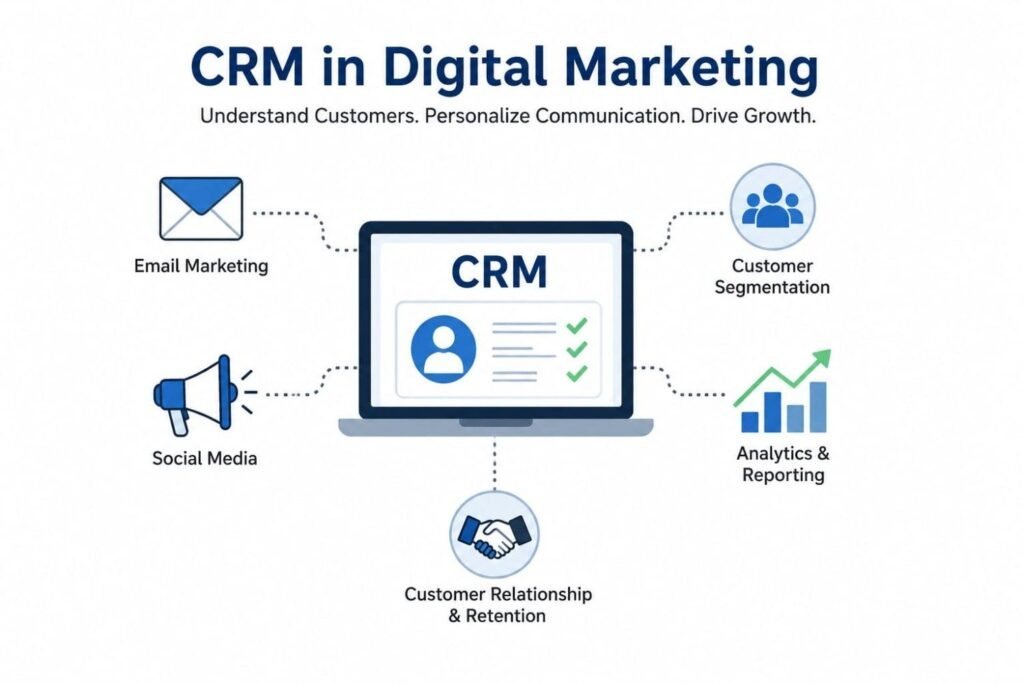
CRM in digital marketing has become an important part of modern marketing, helping business understand their customers and create more relevant campaigns. If you’ve spent any time around digital marketing, you’ve probably heard the term CRM thrown around like everyone already knows exactly what it means. But ask five marketers to explain what a CRM actually does for a marketing team, and you’ll likely get five different answers — some focused on sales, some on email, some on customer service.
That confusion is worth clearing up, because a CRM isn’t just a sales tool that marketing occasionally borrows. It’s quietly become one of the most important pieces of infrastructure behind modern digital marketing — the thing that turns scattered customer data into campaigns that actually feel relevant to the person receiving them.
This guide breaks down what CRM systems really are, how they connect to digital marketing in practice, and what beginners get wrong about them.
What Is a CRM System, Really?
Basically, a CRM is software that helps you keep track of information about your customers and the people who might become customers. This includes things like their contact information, what they have bought from you, what they are interested in and how they have interacted with your business”. It can also show where they are in the buying process.
You can think of a CRM as a way for your company to remember things. Without a CRM this information is usually over the place. In different spreadsheets in someones email inbox or in a notebook that a salesperson carries around. But with a CRM all of this information is in one place so your marketing team, sales team and support team can all use it.
There are some CRMs like HubSpot, Salesforce, Zoho CRM and Pipedrive. Each of these CRMs has its strengths but they all work in a similar way: they help you keep all of your customer information in one place so you can actually use it to help your customers and make your business better. Customer Relationship Management is really important, for any business. A CRM is a big part of that.
Why CRM Matters to Digital Marketing Specifically
Marketing has always been about reaching the right person with the right message. The problem is that “right person” and “right message” are impossible to define without data — and that’s exactly what a CRM provides.
1. Customer Data Management
Every digital marketing channel, such as email, social media ads, website forms and live chat gives us information about the people who are interacting with our brand. A Customer Relationship Management system or CRM for short takes all this information. Puts it into one place so it is easy to find and use. This is the base that everything else is built on. The reason for this is that things like segmentation and personalization of our marketing efforts are really only as good, as the marketing data we have to work with. We need digital marketing data to make these things work well.
2. Lead Tracking and Nurturing
Not every person who comes to a website is prepared to make a purchase today. A CRM helps marketers see where a lead is, in their path. Maybe just looking around or actively looking at choices or prepared to speak with a sales representative. And adjust the next steps based on that. Of sending the same message to all people marketers can help leads grow by giving them information that fits where they really are.
3. Customer Segmentation
Because a CRM holds detailed data on each contact — purchase history, industry, engagement level, location — marketers can group audiences into meaningful segments instead of treating every subscriber the same. A first-time visitor and a five-year customer shouldn’t get the same email, and segmentation is what makes that distinction possible at scale.
4. Personalized Communication
People usually ignore marketing. A Customer Relationship Management system makes it possible to make emails and offers personal. It even helps target ads based on what the person does. Like what they look at what they buy or what they click. This is a reason why marketing that uses a Customer Relationship Management system does better than marketing that treats everyone the same. Customer Relationship Management systems are really good, at helping us understand what people like and what they do not like.
5. Customer Retention
Acquiring a new customer is widely understood to cost more than keeping an existing one, which is why retention is a major focus for CRM-driven marketing. CRMs help by flagging inactive customers, tracking satisfaction, and triggering timely check-ins or loyalty offers before someone drifts away quietly.
How CRM Fits Into the Bigger Digital Marketing Picture
connects all the marketing work we do.
Customer Relationship Management is like the link between marketing efforts.
We use Email marketing and Customer Relationship Management together so we can make campaigns that are based on what customers do like when they leave something in their cart or download something.
We do not just send campaigns to a list of people.
Paid advertising is also better with Customer Relationship Management because we can make groups of people who’re like our existing customers.
We do not have to guess who might like our product.
When we use Customer Relationship Management for Content marketing we can see what our customers like to read about or watch.
So we can make content that’s just for them.
The Sales team and the Marketing team work better together when they use Customer Relationship Management because they are looking at the information about each customer.
They are not working with information that might not be correct.
So Customer Relationship Management does not replace the ways we market to people.
It makes each way of marketing better by giving us the information, about our customers.
Benefits of Using a CRM in Digital Marketing
Customer information is in one place so we do not have duplicate or conflicting data.
This means we can have relevant campaigns because our messaging is based on what the customer actually does not what we think they do.
The sales and marketing teams can focus on the customers who’re most likely to buy from us, which is better lead prioritization for the customer information.
When customers interact with us it feels consistent whether they talk to the marketing team the sales team or the support team, which improves the customer experience, for the customer information.
We also get reporting because we can see how our campaigns are actually affecting the customer not just how many people are clicking on things, which helps us understand the customer information better
Common Challenges (and Honest Realities)
CRM systems aren’t a magic fix and its important to be honest about the difficulties that come with them:
Data entry is only as good as the people doing it. A CRM filled with outdated information becomes unreliable quickly and fixing it later is a real time cost.
Adoption is a problem. Teams that are used to spreadsheets or informal processes often resist switching and a CRM only works if people use it regularly.
Integration isn’t always smooth. Connecting a CRM to email tools, ad platforms and websites can involve a learning curve, technical setup or extra tools.
Cost can increase, for small businesses once you consider per-user pricing extra features and premium options.
Over-personalization can cause problems. There is a line between “this brand gets me” and “this feels invasive ” and marketers need to be careful, about how behavioral data to use in an obvious way.
None of these are reasons to avoid CRM systems. They are reasons to prepare for them properly with processes and realistic expectations instead of thinking the software will fix everything by itself.
Practical Tips for Beginners Exploring CRM Tools
Customer information is stored in one place so we do not have duplicate or conflicting data.
This means we can create campaigns that’re more relevant to our customers because we are using real information, about what they do not just what we think they do.
The sales and marketing teams can focus on the customers who’re most likely to buy from us, which is a better use of their time.
When customers interact with our company they have an experience because everything feels consistent whether they are talking to the marketing team the sales team or the support team.
We also get reports because we can see how our campaigns are actually affecting our customers not just how many people are clicking on things.
FAQ
1. Is Customer Relationship Management meant for sales teams?
No way. Customer Relationship Management systems are really useful for marketing teams too. Marketers can use the information they have about customers to understand the kinds of people they are trying to reach create marketing campaigns that actually matter to them make the communication more personal and see how a lead goes from the first time they talk to the company to the final purchase of a product.
2. Is Customer Relationship Management for small businesses?
Yes. A Customer Relationship Management system can be really helpful when a business has only a few customers. Keeping all the customer information in one place makes it a lot easier to manage the follow-ups the email campaigns and all the other marketing things that the business does as it gets bigger.
3. How is a Customer Relationship Management system different from an email marketing platform?
An email marketing platform is mainly used by businesses to create, send and see how their email campaigns are doing. A Customer Relationship Management system does a lot more than that. It keeps track of all the customer information what they have done in the past what they are interested in what they have. How the leads are coming along. When these two tools are used together marketers can create email campaigns that’re actually relevant to the people they are sending them to.
4. Can a Customer Relationship Management system create a marketing strategy for a business?
No. A Customer Relationship Management system can support a marketing strategy. It is not a replacement for one. It gives marketers the information they need to make decisions about their customers. The actual strategy. Like what the brand’s all, about who the target audience is, what kind of content to create and how to market the business. Still needs people to plan and be creative.
Final Thoughts
something creativity alone can’t: an accurate organized picture of who the customer actually is.
CRM systems have moved from being a “nice to have” to being genuinely foundational for marketing that actually works. They do not replace creativity or strategy. They give marketers For anyone starting out in marketing understanding CRM isn’t optional background knowledge. It’s part of understanding how modern marketing decisions get made in the first place. The businesses getting the most out of marketing today aren’t necessarily the ones, with the biggest budgets; they’re often the ones who know their customers best and a well-used CRM is a big part of how that happens.